
The Oldest Story
That is where we begin. With my origin story and how I found breath. With consciousness. With the oldest story humans have ever told…
I spent years in chaos. At war with my own body.
I was separated from my mother when I was nine months old. I met her again when I was eighteen. That absence became a kind of knowing. Not a thought. A deep sense that something was fundamentally wrong with me. That I wasn’t worthy. That I wasn’t lovable. By grade school, I carried the conviction of “live fast and die young” and that I wouldn’t live past thirty-five. I lived inside that belief for decades. It showed up as recklessness. A disregard for my own body. I played basketball in high school and for a few years at a small college. I regularly pushed through pain, playing through injury, bone spurs in my feet, and severe low back pain that bothered me for years. Then, a motorcycle accident when I was 19 opened the floodgates. A decade of chronic injury followed, including multiple concussions, joint dislocations, and six knee surgeries.
I treated pain like an enemy. I was angry. Resentful. Entitled. A victim. I chose self-destruction. The scars were everywhere. Physical. Mental. Intellectual. Emotional. Spiritual. I was lost. But, at the same time, I was seeking answers. I was studying the body, trying to figure out what was broken. I was in the gym. Trying to understand the mechanics of my own system. I was working, but at the wrong level.
When I turned thirty-five, my son was born at the same age I’d expected to die. Emergency C-section. The umbilical cord was wrapped around his neck. The nurse handed him to me. His blue eyes were wide open. Looking right at me. In that moment, everything changed. I had a purpose. My life had meaning. I had a reason to listen. I got introduced to teachers. Movement teachers. Spiritual teachers. Teachers of music and song. Something I have since learned is that all good teachers of movement arts begin with the practice of breath. So I started engaging with breath.
Across all human cultures and spanning centuries, I found the same pattern repeating:
Consciousness breathed into form, transforming chaos into life.
Engaging with what these stories suggested, breath, then movement, then meditation, all practiced with intention, the chaos didn’t disappear. But I was no longer a passive victim of it. I learned to move differently through life. The tools these stories offered did not transform my circumstances, but instead, transformed how I responded to them. Day by day, small intentional choices guided by patterns humans have been following for thousands of years.
These stories became my instruction manual for a life shaped by intention rather than reaction.
Now I’m going to show you three of them. As you read, do you see yourself? Is there something here that resonates with how you move through chaos and transformation?
The Pattern Across Creation Stories
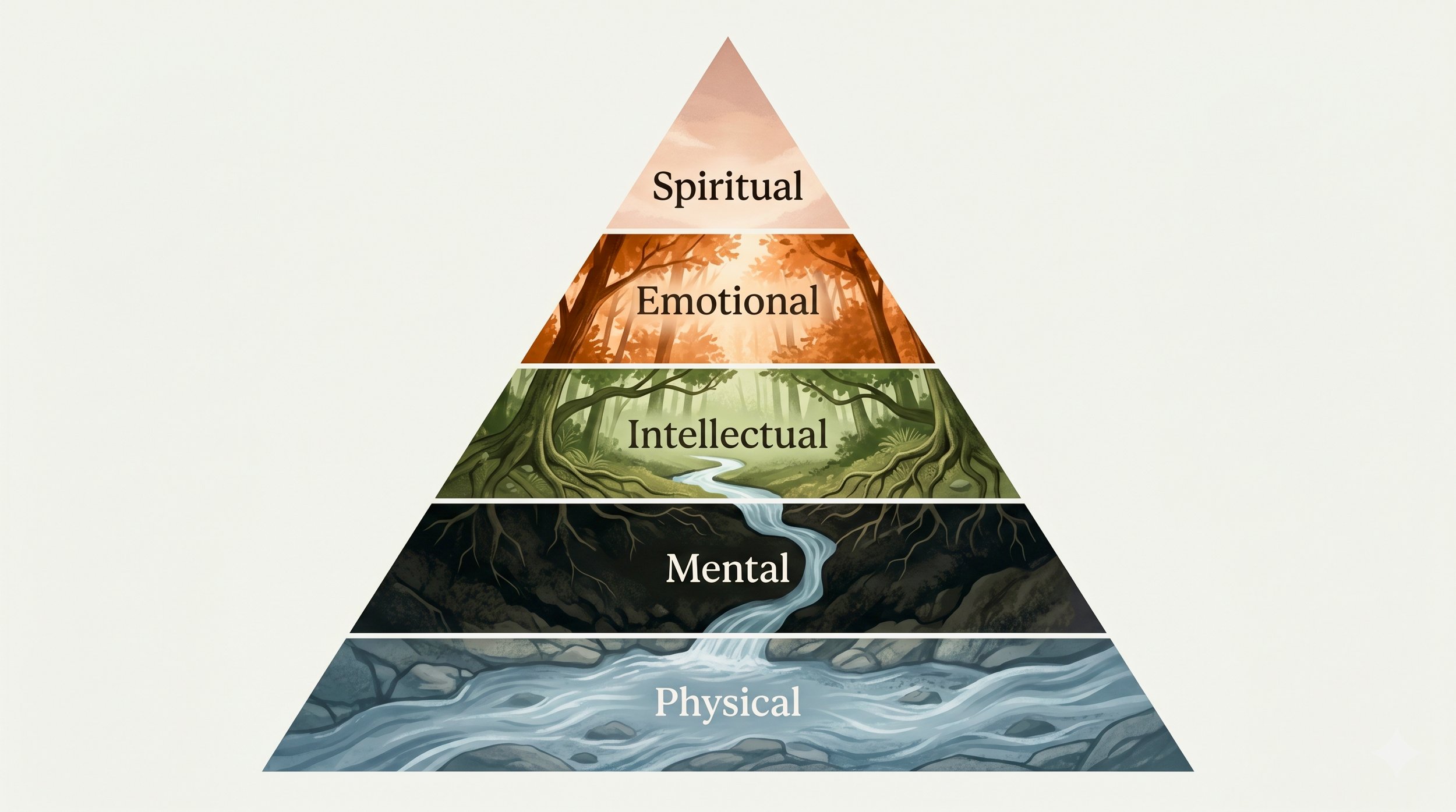
The Pyramid, the framework on which this series is built, has five layers: Physical, Mental, Intellectual, Emotional, and Spiritual. These layers don’t exist in isolation; they communicate through the autonomic nervous system. And across every creation story that has survived for thousands of years, we see the same movement through these layers, animated by the same force: conscious breath.
Pangu (Daoist Creation)
In the beginning, there was chaos: an undifferentiated void without form, structure, or distinction. From this chaos, Pangu emerged. As Pangu took shape, the chaos began to organize. His breath rose as wind and clouds, carrying moisture and movement through the void. His body became the mountains and rivers, the earth and sky. And as Pangu's form animated the world around him, everything came to life. But the story does not end with creation. Pangu dies, and in his death, he transforms completely. His bones become stone, his blood becomes water, his hair becomes the forests. Death and creation are the same act. The cycle continues endlessly: form emerges from chaos, consciousness animates it with breath, transformation occurs, and from that transformation, new form emerges.
This story shows us the Physical layer, the structure that emerges from chaos. The Mental layer, Pangu’s breath, is the animating force that brings consciousness into form. And the Spiritual layer, the endless cycle of emergence, animation, transformation, and return that maintains coherence across time.
You can explore the traditional dynamics of this cycle in this guide to Pangu.
The Hindu Cosmic Cycle
In Hindu cosmology, Brahman, the ultimate reality and the source of all consciousness, exists beyond form. From Brahman arises the universe itself. The Physical layer manifests: mountains, oceans, earth, and sky, all taking shape. Through this manifest world moves prana, the breath, the life force that animates every layer. It is not separate from the structure. It is the current that makes the structure alive. This creation exists in a state of perpetual maintenance, held together by divine force. Yet maintenance is not stasis. The universe is constantly transforming, held and released at once. And then, inevitably, dissolution comes. Everything returns. The manifest dissolves back into Brahman. And from that dissolution, creation emerges again. The cycle repeats. Prana moves through all of it, the emergence, the maintenance, the dissolution, and the return, connecting every layer and animating the whole.
This story shows us all five layers of the Pyramid working together as one system. The Physical layer manifests. The Mental layer carries prana, the connective current, through it all. The Intellectual and Emotional layers maintain and transform the created world. And the Spiritual layer, the source from which reality comes, is also the readout of whether the whole system is integrated or compensating.
This continuous loop of creation and return is central to the Hindu cosmic cycle.
The Mayan Creation (Popol Vuh)
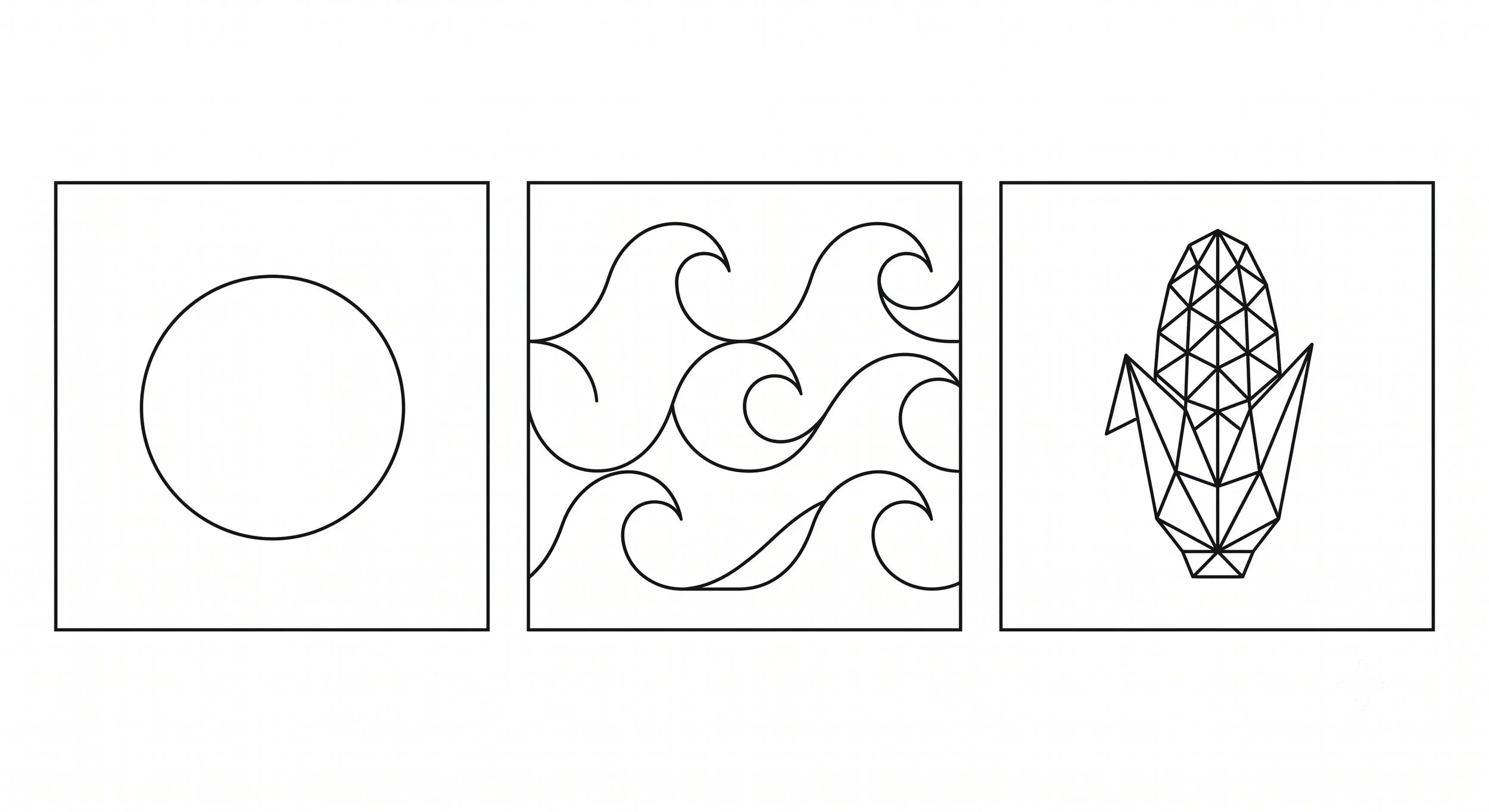
The gods attempted creation multiple times. First, they shaped humans from mud, but the forms crumbled. They tried again with wood, but these beings had no heart, no memory, no consciousness. They could not see. They could not know. They were empty shells. The gods learned from failure and tried once more. They shaped humans from corn, a substance that could nourish and sustain life. But form alone was not enough. The gods breathed consciousness into these corn-beings, and something fundamental changed. Suddenly, the created beings could see the world around them. They could think, remember, feel, and know. They could recognize the gods who made them. They could participate in a relationship with the cosmos itself. Consciousness breathed into form, and awareness awakened. The beings were no longer passive. They were alive. This story shows us the Physical layer, the successive attempts at form, and finally the corn-body that holds structure. The Mental layer, the breath of consciousness entering and animating. The Intellectual and Emotional layers, the awakening of thought, feeling, memory, and relationship. And the Spiritual layer, the participation in something larger than oneself, the connection to the cosmos and to the divine. The progression from inanimate matter to conscious awareness is beautifully detailed in the Popol Vuh creation account.
My Interpretation of These Stories
I am reading these myths through the lens of my human experience. This framework is a personal synthesis. Not a universal theological claim.
These three stories come from different cultures, different times, and different worldviews. The chaos of undifferentiated potential becomes an organized structure. The structure becomes animated through breath. And the animation creates the possibility of transformation. Each one ends at the same test: whether what's been animated holds together, integrated and coherent, or strains under its own weight, compensating instead of integrating.
I spent years studying these stories across traditions before I understood what they were actually teaching. They weren’t describing a distant mythological event. They were describing a process that happens in every moment, in every breath, in every choice to engage with your own life consciously rather than reactively.
These stories survived thousands of years because they work. They embody something real about how transformation happens. How chaos becomes order. How unconscious potential becomes conscious participation.
And all of these stories point to something more specific than consciousness breathed into form. In each one, form comes first. Structure exists before it does anything. Then breath enters, and only then does that structure move, think, feel, or reach toward anything beyond itself. Breath isn’t where these stories begin. It’s the hinge between having a body and having a life. That conscious breath, breath taken with intention and awareness, is what creates transformation. Not unconscious respiration. Not the simple fact that everyone breathes. But breath is the vehicle by which consciousness animates the body and changes how a person moves through life.
That is what this project does. It takes what these ancient stories intuited, that conscious breath is the entry point to transformation, and it explores that claim through three different lenses: scientific, philosophical, and theoretical. The goal is a practice rooted in real physical structure that, engaged with intention, creates meaningful change in how you function and feel.
Not by making pain disappear, but by offering tools to move through pain consciously and intentionally, guided by patterns that have held true across cultures and centuries.
And. This is where we begin, again. With each of our origin stories. With breath. With consciousness. The oldest stories humans have ever told…
For the full picture of how those five layers work together, the Pyramid lays out the map in detail. From here, the question turns physical: what breath actually is, structurally, inside a body built the way ours is. That’s where the next piece in this series picks up - Breath Defined.