

The Pyramid: An Introduction to the TAOFit Method

The Missing Map: Understanding Your Pain as a System (Not a Symptom)
You have probably tried something for your pain. Maybe it was a quick fix. Ice, heat, a painkiller, or a hot bath. Maybe you sought help from a chiropractor, a massage therapist, a physical therapist, or a doctor.
Maybe the symptom faded, and you moved on, until it came back weeks, months, or years later. Maybe it never went away at all. Whatever you tried, the pain returned. And often a little stronger than before.
It started small with a signal: a painful first step out of bed in the morning, the feeling of something being "off", lingering tension in your hips, back, shoulders, or neck. Slowly becoming the new baseline. More days than not, reaching into the medicine cabinet for a pain remedy.
This leaves you with a question no one seems to understand: If I’m doing everything right, why do I still hurt? Am I broken? Is this the new normal?
The problem is not always about effort. Most people who end up here have tried hard. The issue is something more fundamental. When you define a problem incorrectly, your solutions will not work, no matter how well you execute them.
Most conventional approaches define the problem as the symptom. The back pain. The anxiety. The disrupted sleep. But those are descriptions of what the system produces, not of the underlying cause. Treating the output without addressing its source does not resolve the pain.
Redefining Pain: The Universal Signal
Pain is not a character flaw. It is not a sign that you are weak, broken, or doing something wrong. Pain is a signal. It tends to mean something in the system is dysregulated and asking for attention. That distinction matters more than it might seem at first. When pain is viewed as a personal failure, the response tends to be self-judgment, shame, avoidance, or pushing through. But what if there were another way to understand it?
Most people respond to persistent pain by targeting the most obvious or most accessible layer. This may be the physical symptom, the anxious thought, the emotional pattern, or the search for meaning. These are reasonable responses.
But they often fail to produce lasting change because they address only one part of a system without seeing the whole. This is called bypassing.
Bypassing occurs when higher-level processes, such as intellectual understanding or emotional reframing, are used to avoid or override unresolved signals from lower levels of the system. Without a grounded physical foundation, these processes have no stable base to build on. The signal tends not to resolve. It continues operating beneath the surface, shaping behavior and experience.
The Pyramid: A Map of the Human System
The Pyramid is a map of that system. It is not a program or a protocol. It organizes human experience into five layers, built from the bottom up. These are the physical, mental, intellectual, and emotional layers, with the spiritual layer representing the lived experience of how well the first four work together. These layers are not separate compartments. They communicate continuously in both directions through the autonomic nervous system. What happens in one layer does not stay there. It moves through the entire system in both directions. Understanding the map helps you see where you are and what the system around you is doing.
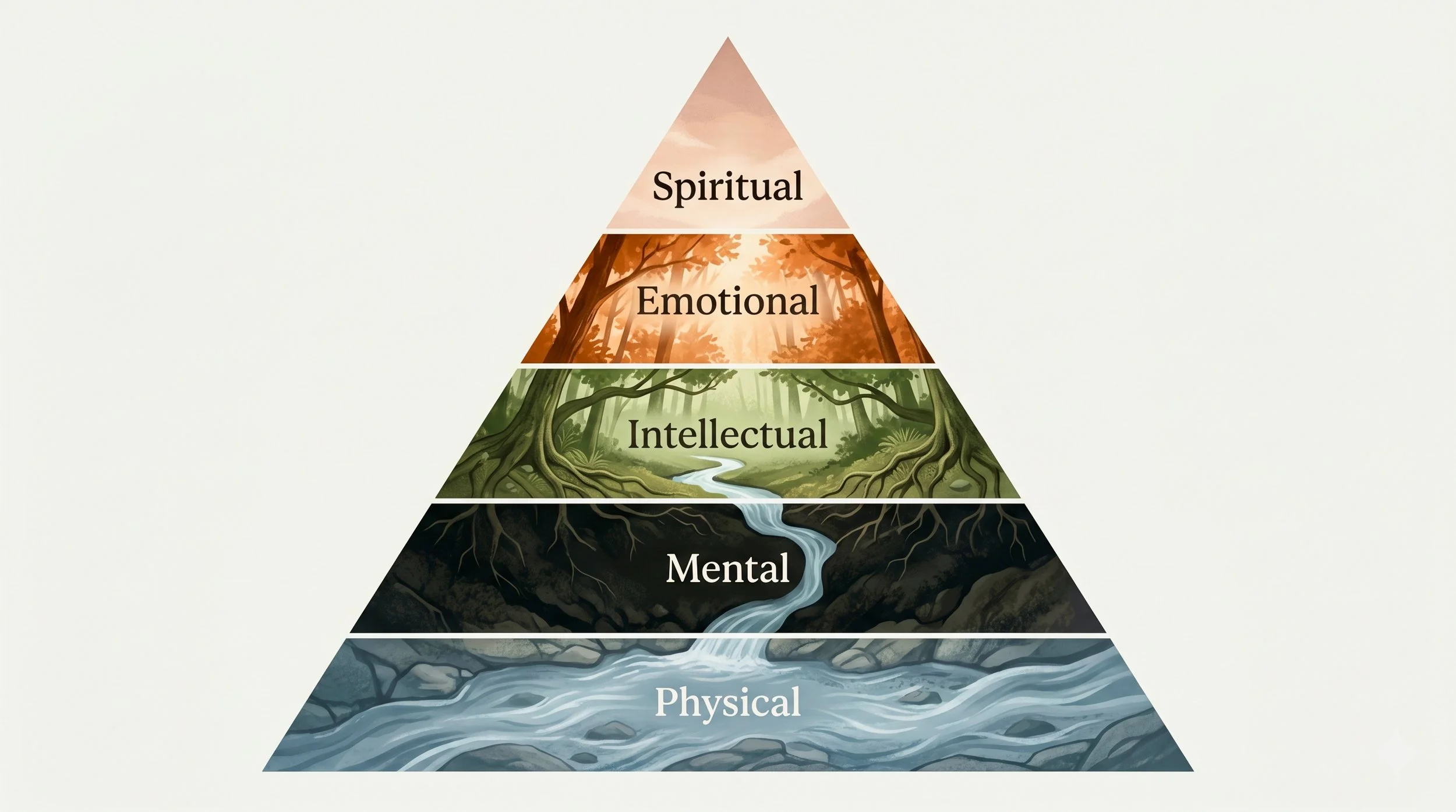
Think of the autonomic nervous system as a river. The current runs in both directions through all five layers simultaneously. The water carries the quality of each layer it passes through, whether clean or polluted. The language of movement is how we read that quality. Stuckness, rigidity, immobility, and inflexibility describe what happens at every level when the system is dysregulated. Flow, mobility, and flexibility describe what happens when it is not. These are not loose metaphors. They describe the same phenomenon appearing at different levels of the same system. Whatever is true on any one layer is simultaneously true at every other layer. Physical stuckness is mental stuckness. Mental stuckness is emotional stuckness. Emotional stuckness is spiritual stuckness. They are the same current, carrying the same quality, arriving everywhere at once.
This map is useful for three reasons:
The layers are mechanically interdependent. What happens at one level travels through all of them via the autonomic nervous system. A disruption at any level sends the signal upward and downward simultaneously.
Bypassing does not produce lasting change. Addressing upper layers without first addressing the physical foundation fails to achieve sustained regulation. The signal driving the dysregulation remains unchanged regardless of what shifts above it. This is not a willpower problem; it is a sequencing problem.
The movement language gives you a diagnostic tool. Once you can name the quality of the current at any level, you stop asking why you are like this. You start asking which layer needs attention right now.
Why the System Gets Stuck in the First Place
We are biologically wild humans living in a modern, domesticated environment. Our nervous systems evolved to handle acute threats. Think of what happens when your body senses a bear in the woods. Blood flow redirects away from the frontal cortex and the digestive system and toward the heart, arms, and legs. The system prepares to fight or flee. This is a brilliant survival mechanism. It is also ill-suited to the realities of modern life.
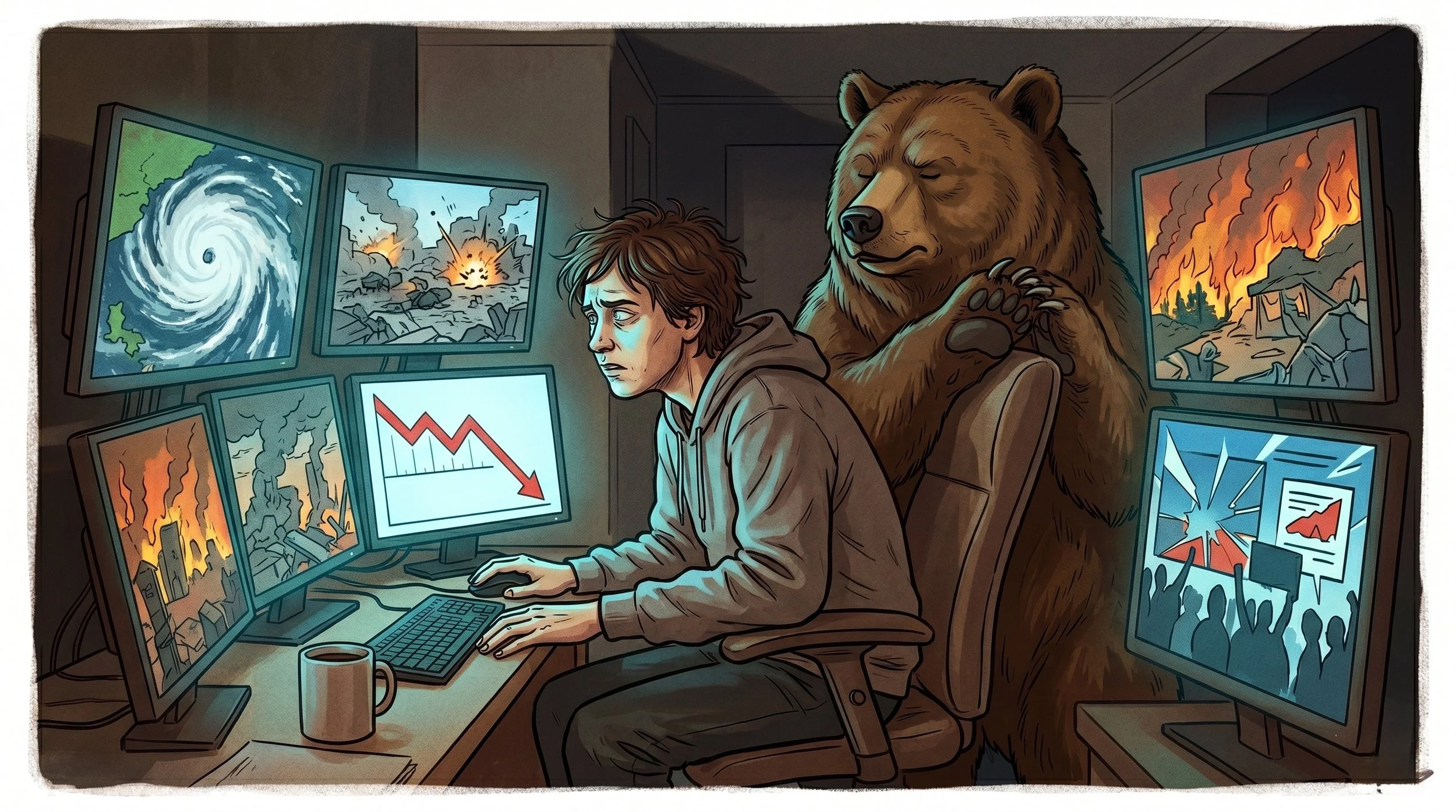
The modern world does not present bears. It presents screens delivering 24-hour bad news, chronic low-grade stressors, and persistent micro-triggers that bombard the oldest part of the brain with signals of constant threat. There is no bear, but the nervous system does not know the difference. It runs the same survival response. Not once, but continuously. A perpetual state of fight, flight, freeze, or fawn.
The long-term cost of living in that state appears first in the body:
Elevated tension in the neck, shoulders, and back.
Increased wear on the fascia, joints, and heart.
Disrupted sleep.
And because every decision the system makes in survival mode is biased toward the immediate threat at the expense of long-range thinking, the cost extends into relationships, finances, and the overall sense of direction over time.
This is the environment the Pyramid is responding to. The system is not broken. It is running an ancient survival program in a world that never lets it stop.
The Five Layers of the Pyramid
The Physical
The Physical layer is the body. But not the body, the way we usually think about it. Not just muscles, joints, and tissue. The body is the only interface between your consciousness and the world around you. Every sensation you have ever had, every perception, and every experience, has come through this layer. Without it, there is no reality as you know it.
This is not a philosophical abstraction. It is the most practical thing about you. Every sensation, every breath, every postural pattern, every movement habit is continuously feeding information through the autonomic nervous system to every other layer of the system. The layers above use that data to construct their understanding of what is safe, true, and real.
The Mental
The Mental layer is your hardware and survival software. It is the oldest part of the system. Sometimes referred to as the reptilian brain. Running long before language, thought, or conscious awareness existed. Its job is to take what comes through the Physical interface and answer one question before anything else: is it safe?
Of the layers, this is the one you have the least direct ability to change. It appears difficult to upgrade through thought, study, or will power alone. What you may be able to do is influence the quality of the signal processing through the body, through movement, and through breath.
The Intellectual
The Intellectual layer runs the executive function of the system. It is the layer of learning, skill, mastery, reason, logic, and abstraction. It builds understanding, assigns meaning, and develops the capacity to navigate complexity. Unlike the layers beneath it, this one grows in direct response to input and experience. Its primary power is inhibition. This is the ability to observe a signal from the layer below and choose a response that serves a longer-term goal rather than an immediate one.
This is the only layer capable of consciously retraining the layers beneath it over time. The Intellectual layer, along with the Emotional layer, is what many people mistake for the whole of human experience, because they are the layers most experienced as the self.
The Emotional
The Emotional layer is associated with what is sometimes referred to as the limbic system, the part of the brain most closely linked to emotional processing and survival response. It tends to govern the system's state through the autonomic nervous system, influencing both the urgent survival response and the capacity for rest and regulation. It sits above the Intellectual layer for one precise reason. It can take the Intellectual layer offline, but the Intellectual layer may not be able to do the same in return. Where the Intellectual layer asks what something means, the Emotional layer has already decided what it is worth. It assigns urgency, significance, and survival weight to incoming data faster than conscious thought can intervene.
When the Emotional layer is overwhelmed, the survival response tends to bypass the Intellectual layer entirely. It stops analyzing. The only reliable path back runs downward through the system, through the body, through movement, and through breath.
The Spiritual
The Spiritual layer is the highest layer of the Pyramid, not because it sits at the top of a hierarchy, but because it is where the self is fully lived. This is not a religious concept. It is the layer of identity, coherence, purpose, direction, and your connection to something larger than yourself. It is the only layer where thinking, feeling, moving, and processing are not separate events but a single embodied experience.
When the lower layers are integrated, this layer provides coherence, orientation, and presence. When they are not, it feels like stuckness, rigidity, and disconnection, or a quiet sense that something is fundamentally off. It cannot regulate itself from within. It can only reflect what the layers beneath it are producing.
This is where the self arrives. How fluid or stuck that experience feels depends entirely on what the layers below have produced. If the Spiritual layer feels dysregulated, that is not where the problem originates. It is where the problem becomes most visible. The stuckness you feel at the level of identity, purpose, and meaning is a downward-pointing signal. That is where the work begins.
Where it Begins
The signal pointing downward from the Spiritual layer passes through every layer beneath it. When the Emotional layer is overwhelmed, the Intellectual layer cannot reason its way back. Telling yourself to calm down often does not work because the Emotional layer has already bypassed the Intellectual layer's authority. The only reliable path back to regulation runs downward through the system, through the Mental layer and into the Physical layer, where the autonomic nervous system actually lives. The most accessible entry point into the autonomic nervous system is the one process in the human body that is both automatic and consciously directable. That process is breath. That is where the next conversation begins.